The Greater Earthship Community is a movement led by architect Michael Reynolds starting in the 70’s, based on the premise that basic human needs should not be subject to economic fluctuations. His solution involved building affordable housing, coined ‘earthships’ after the self-reliant qualities of sailing ships. They use similar principles to the way native Puebloans had been living in the four corners region for 2000 years -- a large thermal mass to maintain comfortable temperatures, orientation to sun for heating and plant growth, and internally interdependent networks for energy, water, temperature, and plants.
The Greater Earthship Community consists of 60 or so earthships in a development outside of Taos with space for a hundred more. There are several satellite communities in the New Mexico area, and thousands more individual earthships across the US and many overseas in a variety of environments ranging from 14000 ft in Bolivia to the Yukon to the tropics.
Earthsip Biotecture is the architectural and fabrication business associated with the Greater Earthship Community. Most recently they have worked on designing structures for Haiti and Indonesia post-natural disaster to provide affordable shelter and clean water. The earthships are completely self-sustaining. There are no power, water, or sewage lines running to or from the structures, although some owners choose to have conventional utilities as a back-up system both to comply with local building codes or for re-sale value.
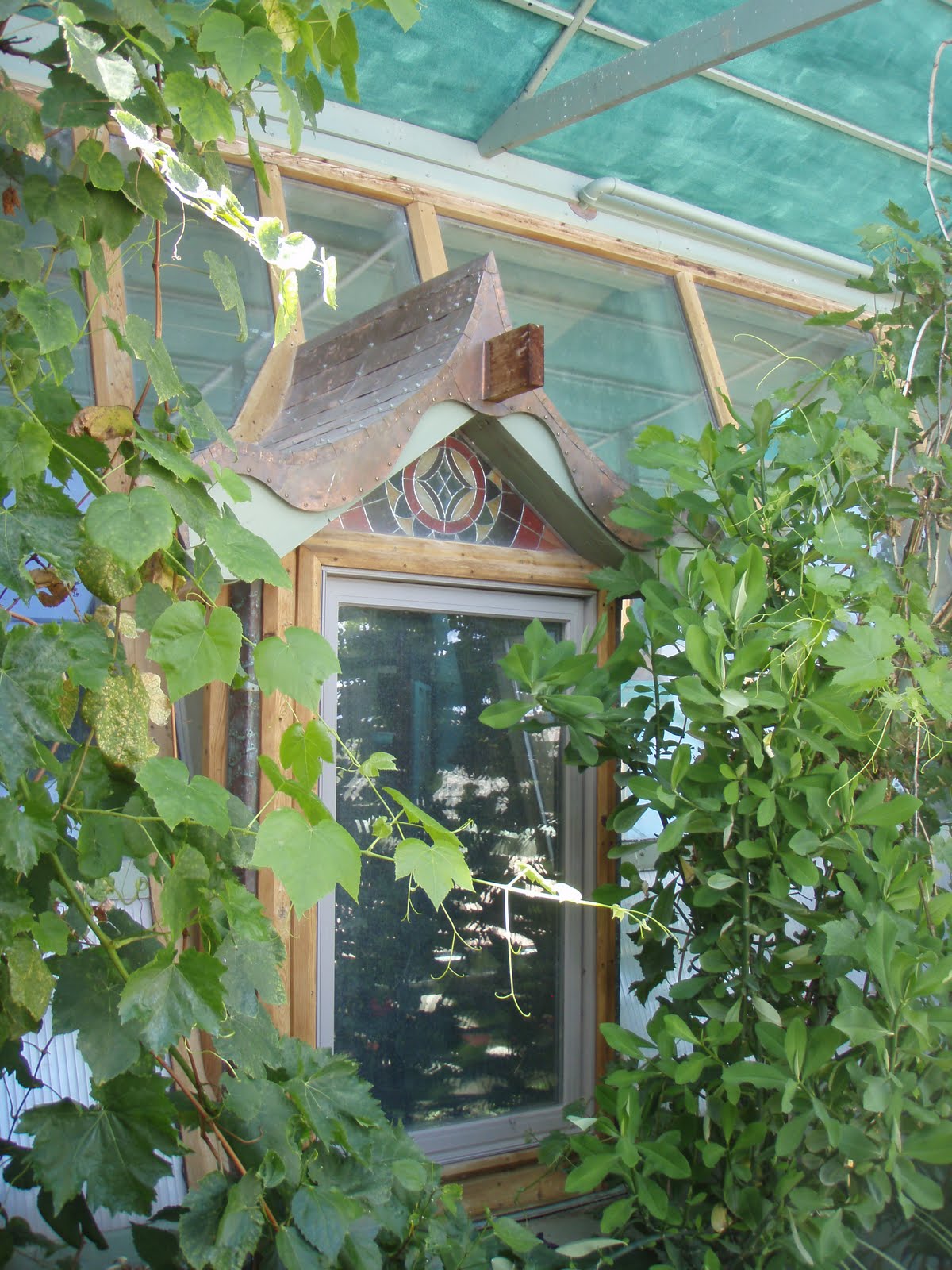
Building techniques are straightforward but physically strenuous, and many of the materials used are recycled and widely available. The basic building consists of a large south facing greenhouse for heat and light and north facing compacted earth wall to store heat that warms the inside in the winter and cools it in the summer. Electricity is provided by solar panels mounted to the south-facing attached greenhouse. We spent a week in an earthship and although the temperatures outside ranged form 40 to 90, it didn’t vary from 70 to 75 inside, without any sort of air conditioning or heater.
Water is collected from the metal roof surface into a set of cisterns, and is used 4 times before it is ultimately channeled to an outside garden. After being collected in the cisterns is it filtered for contaminants and used as drinking and washing water in the faucets and sinks. Then, it is considered ‘grey water’ and is sent through several long planters in the greenhouse and inside windows of the structure. After the greywater is filtered through the drit, gravel, and root systems in the planters it is collected for use in the toilets, and then pumped outside to a conventional septic tank that feeds into an outdoor greenspace. Ultimately, the result is that 1 gallon of water used in the earthship does the work of 4 gallons in a conventional home. The Greater Earthship Community development gets only 7-9in of precipitation a year, yet this is enough for a 2 br, 1 bath home.
The home we stayed in had a 9-ft banana tree in the living room which was sustained entirely by the greywater system. In another earthship there were fish, grape vines, and tropical birds living inside. Outside, it is a sagebrush desert that reaches 120 deg F in the summer, yet this ecosystem had been thriving for years.
We took showers, ran blenders, watched TV, and turned on lights as we normally would, yet didn’t want for electricity, water, coolness or heat. In fact, we only ran into problems when we didn’t use enough water in the sinks to provide greywater for the planters and had to occasionally water the greenhouse plants by hand.
It appears the biggest hindrance to future earthship construction is navigating the building codes of various counties across the US, which were written assuming conventional construction techniques and materials.
http://earthship.com/
http://www.garbagewarrior.com/about.html
Tuesday, June 1, 2010
Saturday, May 29, 2010
Hell's Backbone
Southern Utah conjures up many connotations. Polygamous nutcases, redrock canyons, Ed Abbey, and the Grand Canyon are a few. Within the raw, scorching desert the name Hell’s Backbone implies more sun, ATV’s, and lizards than normal.
No-harm Buddist organic farming wasn‘t immediately on my mind as we stopped in a cloud of dust at Hell‘s Backbone Grill in Boulder, Utah. Not only were traditional prayer flags fluttering on the porch, they have the best tasting food in the entire state of Utah.
Blaker’s Acres, a farm located down the road from the Hell’s Backbone, supplies produce to the restaurant. The manager of Blaker’s Acres took an entire morning to show us around and describe the Buddhist-inspired principles on which the farm operates.
Obviously, plants were killed to be eaten. Otherwise, the farm operated as ‘No Harm’, meaning no pesticides, traps, or implements that would harm the multiple little creatures wanting to feast on the tasty plants. There were a variety of methods used to do this. Specific companion plants, when grown together, provided odors and/or tastes that would repel certain insects. They plant extra produce with the expectation that deer and other fauna will find their way through fences or into cold cellars. In addition, there are strong ties to orchards and ranches around Boulder to supplement the farm’s provisions through a fluid semi-barter economy in the absence of substantial hardware and grocery stores for a hundred miles.
And, should an infestation take a portion of the crop, or seasons change, the chefs at Hell’s Backbone adjust their menu to what is available. I was personally skeptical of the pumpkin and tumbleweed enchaladas, but they were fantastic (it turns out that young green tumbleweeds are quite tender and tasty).
In addition, the restaurant gets its meat from ranchers a couple of miles away. I think that it is fair to say that despite the variety of ideological, theological, and background experiences of the folks involved with Hell’s Backbone, their mutual dependence creates a strong community.
Tuesday, May 11, 2010
Green River
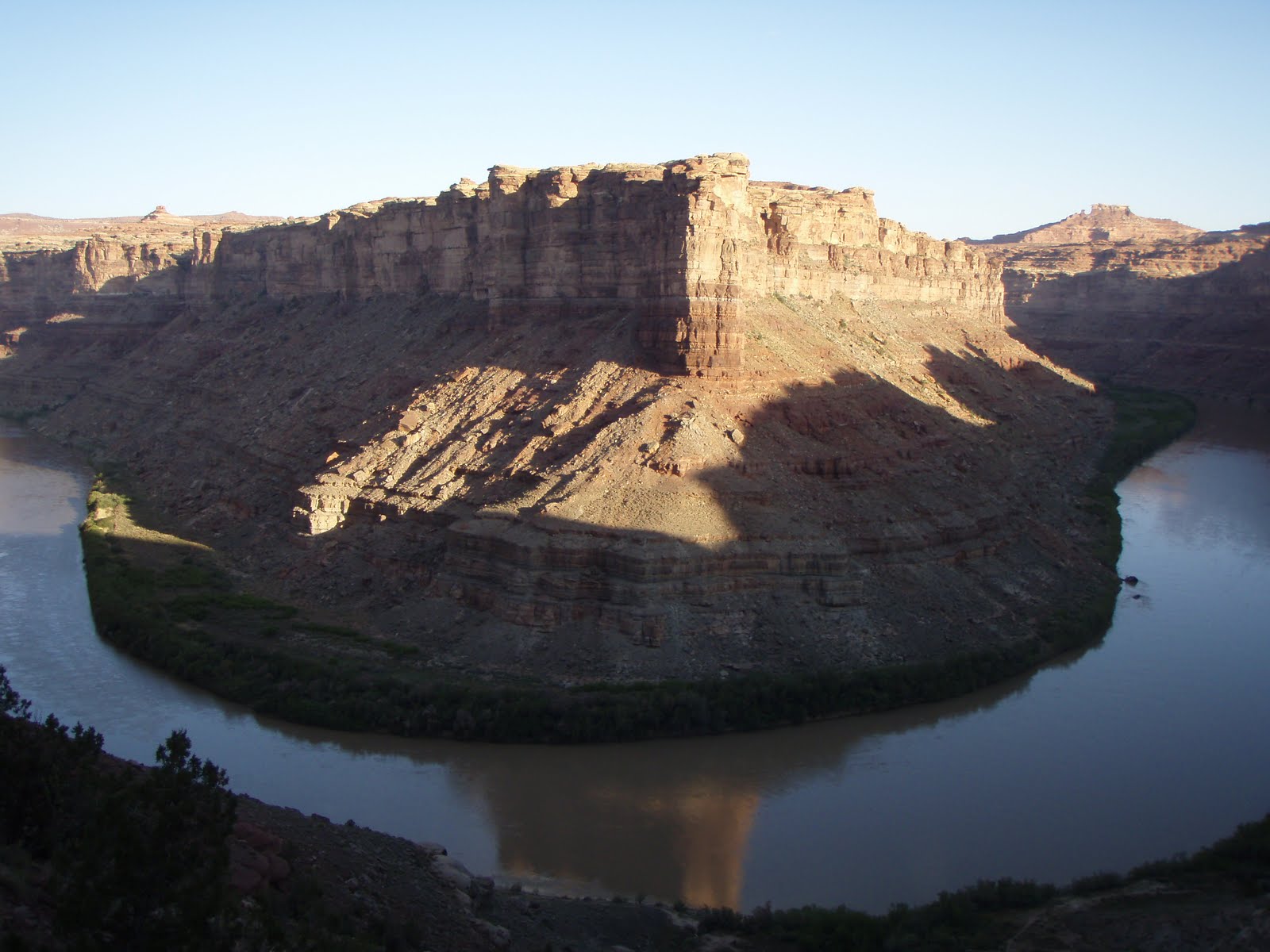
For the last 14 days Joe and I have been on the Green River, canoeing, hiking, and backpacking into the Maze district of Canyonlands National Park. I went into the experience with the desire to be closer to the natural world: to wake and to sleep by the rising and setting of the sun, to witness the rhythms of life in the wild, to allow the elements to carve away what is dead and awaken what is pure and whole and real.
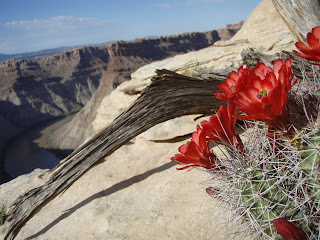
After 70 mph winds, 2-3 foot swells, whitecaps, snow, blazing sun, families of geese, snow egrets, the welcomed shade of cottonwoods, mountain lion tracks, panels of 3500 year old pictographs, blue herons, long stretches of silence, water-carved canyons, desert flowers, hanging gardens, and star filled skies...I feel alive. Having spent time in the desert before, this didn't surprise me. The desert has a way of removing excess baggage.
What I wasn't expecting on the river was to find a connection to humanity. I usually go into the wilderness to get away from people but on this particular trip I found myself enjoying the people we met. It was, in a way, another kind of community. A temporary community made possible by a common experience of a river. We put in at Crystal Geyser with a family from Seattle and Durango. Two days later we were sharing stories of 70 mph winds over breakfast, another day later and we shared a campfire at Horseshoe canyon.

Three days later we met a group of three guys from Minnesota on an island not marked on the river map. They invited us to their camp for dinner a campfire and we shared stories over sips of whiskey long after the stars began their nightly showing. Before we headed back to our tent, Rol, an avid paddler, canoe racer, and retired teacher, opened up a back pack full of candy bars, skittles, trail mix and M&M's and insisted we fill our pockets. (A welcome gift to the couple who brought a bare bones, no frills menu)
A couple of days later we arrived at Spanish Bottom where we planning to backpack into the Maze for a few nights. We weren't sure if we were going to go because we didn't know if know if there was any access to water. Not a half hour later a group of folks that had just been backpacking in the Maze came by and assured us there was plenty. The group happened to be a professor of prehistoric rock art and three students who had just spent a few days with the harvest scene. I learned more about rock art in a half hour with Ike than all my previous knowledge combined.
And then at the end of our trip on the jet boat back up the Colorado River and bus back to Moab, we met a couple from Australia, Tom and Claire, a pair of modern nomads who travel most often by foot, sleep most often in a tent, and find hiking the Himalayas on the India/China border without maps not all that big of a deal.
When I remember the Green River I will remember the long stretches of solitude, where the only thing you hear are the wings of the geese flying overhead and all that you see in front of you and behind you is the river winding through layer upon layer of the earth. When I remember the Green I will also remember the people we encountered for only a brief time but whose presence was as remarkable and lasting as any vista or view.
Friday, April 23, 2010
Findhorn Foundation
So here I am sitting in The Elephant House, the coffee shop where J.K. Rowling began writing about Harry Potter. I can see the Edinburgh Castle and the Greyfriars Church graveyard from the window. It makes Hogwarts all the more believable. It is day six of waiting out the volcano - if all goes well we fly back to the states tomorrow. However hard it was at first to accept the fact that we weren’t going to be able to keep our schedule, I am grateful now for the extra days to reflect on the last six weeks, and in particular the most recent week at the Findhorn Foundation.
When I began planning this sabbatical focused on intentional living one of the first websites I found was the Findhorn Foundation. Its homepage said, “spiritual community, education centre, and ecovillage”. That got my attention. Then I discovered that they had a special week focused on eco-villages and I sent in our deposits. I had no idea what to expect but I knew I wanted to go.
I now can’t imagine this sabbatical without it. It is by far the largest and most complex of all the communities we have visited. It has evolved over time and continues to evolve. It is an eco-village and an interactive educational model for sustainability. It is a spiritual community. It is a creative and innovative community. It is an unfolding experiment. There is just no easy way to explain Findhorn. Even after a week of living and working in the community I am not exactly sure how it functions. But it is clear at least from my experience, that it is doing something right.
At the beginning of the week one our leaders, or focalizers as they were called at Findhorn, shared with us the following two statements about sustainable/intentional communities:
1. In communities that last - there is almost always a glue that holds the community together.
2. Sustainability must be fun. If it is isn’t fun it isn’t sustainable.
Findhorn definitely had a glue. Again easier to experience than to describe but it was about the way they connected to one another and to creation. They called it co-creation with nature. What does that mean? For me its something to do with the fact that the vision of being an eco-village does not come out of a moral or ethical obligation to care for the earth but out of a deep sense of connectedness, of oneness with nature and with all creation. This connectedness is not just an idea, it is something lived out in a very simple, very consistent manner. They take time to do what they call an attunement. Before any task, any activity, they hold hands in a circle and become aware of themselves, of one another. They listen for the spirit within. They listen to the elements around them. They pay attention to the energy of the group. They attune to themselves, to one another and to creation. It is a very powerful, simple practice that holds this incredibly diverse, incredibly complex community together. there is much more to say about this - but probably for another post.
I also cant remember a time when I have laughed as much as I did. This experience was fun. Lots of fun. And not superficial fun, but deep, satisfying, real belly-aching fun. And it wasn’t just our group of 25 that was having fun. People were on a whole, happy. Yes you could say it is easier to be happy when you are living in a commune of sorts on the northeast coast of Scotland. But then maybe there is something to learn here, about how people relate to one another, to themselves, to the larger world. There was an ease and a grace among this community that is rare. And I believe it has something to do with the glue that keeps them together.
Is Findhorn perfect? By no means. Does it have all the answers? Of course not. But as far as intentional, communal, sustainable living goes, it has wisdom to share. I am walking away from this eco-village Experience Week with a deep sense of gratitude, not only for the incredible people I met from around the world, (In our group of 25 participants we had people from Australia, Sweden, Italy, Switzerland, United States, England, Wales, Sri Lanka, Hong Kong, Slovakia, Spain, Canada, and the Netherlands) but also for the way it engaged my mind, body and spirit. I haven’t felt this whole in a long time. This thread of connection continues…
More to come…
Monday, April 19, 2010
Iona - A Place of Pilgrimage
The island of Iona has long been a place of pilgrimage. Its magical landscape, religious heritage, and idyllic culture all lend it to being what Marcus Borg calls a thin place, where the line between heaven and earth, the sacred and profane is blurred. Having just visited, I get why thousands make the long journey to this tiny island. It is a powerful place. Though I am thinking I may prefer the description offered by Henry, a fellow traveler I met on Iona during Easter weekend, who said, “I wouldn't say it is thin - I would say it is fat - overflowing - abundant with life and spirit.” Such was my experience on Iona - rich, full, and immense.
Central to the allure of the island is the Abbey, which has a history all of its own. In 563 AD St. Columba established a monastic settlement that spread Christianity to much of Scotland. In the middle ages it became the site of a Benedictine Abbey. In 1938 an ecumenical group of Christians under the direction of George MacLeod, began restoration on the Abbey and today it serves as a guest house and a house of worship for the Iona Community and guests.
The Iona Community is unique to the other communities we have visited so far in that they are specifically Christian community. They are also unique in that they do not necessarily live on Iona. They are a dispersed group of people, about 200 in number, who share a common rule which includes:
Daily prayer and reading of scripture
Mutual sharing and accountability for use of time and money
Regular meeting together
Action and reflection for justice, peace, and the integrity of creation
Every year they welcome hundreds of visitors to the three centers that they oversee and maintain: the Abbey, the MacLeod Centre and Camas Centre, which is on the Island of Mull. Each center is run by both paid and volunteer staff who come from all over the world to live and work in one of these centers. Paid staff come for 1 to 3 years and volunteers come from 4 to 12 weeks at a time. In addition to the staff and volunteers, guests can come to each of these three centers and participate in the life of the community as well. Guests participate in housecleaning, cooking, worship planning and leadership, and grounds maintenance. During our 5 nights on Iona we stayed at the MacLeod Centre.
Worship in the Abbey usually takes place every morning at 9 am and every evening at 9 pm. Being that we were there over Holy Week and Easter, we had additional worship for Maundy Thursday, Stations of the Cross on Good Friday, a Saturday Night Vigil, and a Easter Celebration on Sunday Morning.
It is hard describe what it is to worship in the abbey - voices echoing across the cold stone walls, candles illuminating dark corners, ancient memories lingering between signs of the present - it was beautiful and austere and melodic all at the same time. I came expecting it to be the heart of my experience on Iona - surprisingly the land outside the abbey held just as much if not more power and inspiration. I don’t know that I have ever hiked on land with such history, emotion, and energy. The island speaks a language without words. Its rocky outcroppings, shorelines, sheep herds, boggy marshes, fields of heather and historical sites all give way to an experience of connectedness that satisfies the hearts longing...
There is more to say about Iona - much more - so perhaps this can serve as a beginning…
Tuesday, March 30, 2010
Tranehoej
Tranehoej
Visiting Tranehoej has most certainly been a high light of the trip so far. We found an amazing community of people living together. They were incredibly generous people, both with their resources as well as their time and humor. We were treated to everything from fresh squeezed apple juice to lamb from their own farm to bicycles to explore the area to hours of conversation about Tranhoej and the Danish culture. This was an experience I will treasure for a long time. The following is but a glimpse of that experience…
When I first began to research intentional communities/eco-villages in Denmark there were a couple that seemed to be the more well known, Svanholm (http://www.svanholm.dk) and Munksoegaard (http://www.munksoegaard.dk/index_en.html) - (Svanholm was mentioned a few times by folks at Torri Superiore and was of particular interest to me because of the economic and governing system they have adopted) While neither of these communities have a guest house as a primary project of their community we were hoping to be able to visit the communities and learn more about some of their projects. As it was, for various reasons, we weren’t able to visit either one. But in the midst of researching these and other communities I came across a small community about 80 km outside of Copenhagen called Tranehoej (http://www.tranehoej.dk/en_summery.html)On the English page of their website, after describing their organic vegetable garden, the sheep, the goats and the chickens, it also mentions that as a member of Servas they welcome visitors…
So I sent off an email the beginning of February and a few days later received an email from Gitte Jakobsen telling us that they would be glad to host us for a night and to call us when we arrived in Copenhagen so she could give us directions to their place.
Fast forward 6 six weeks to the middle of March. We call Gitte from Copenhagen and she helps us figure out how to get to Tranehoej by public transportation - the next day we take the train to Jyderup and then catch a local bus to Searslav - where Gitte is outside waiting for us with her dog Emma. After introductions and a short walk we arrive at Tranehoej, a U-shaped compound with a courtyard of sorts in the center of the three buildings.
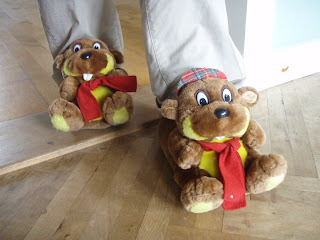
Gitte welcomes us inside, invites us to take off our shoes, and since I don’t have any socks - I get the warmest snuggliest slippers possible…
A former resident, Daniel, who just recently moved back to Copenhagen, happened to be there at the time and he offered to show us around the property. As we walk outside to the garden and sheep pasture we can see and hear the windmills not too far in the distance - the chickens were happily wandering around their spacious coup - we didn’t get to see the goats, but the sheep were grazing on the fields. Next to the chicken coup is the apple orchard - with nearly 175 trees - not all of which they currently harvest.
After a rest in our room, we were welcomed to dinner with the wonderful aroma of bread and chili and rice and vegetables. At dinner we meet the rest of the community - there are three families currently living at Tranehoej - they have the capacity for six families however and were excited to be welcoming a new family in just a week or two. One of their struggles seems to be the distance from Copenhagen. Families find it harder than expected to live this far from the city and there are not a lot of ways to make a living in the countryside.
But among the three families who have found a way to make it work there is a wonderful sense of community - it is quickly evident to me that this is a group of people who know each other well. They seem comfortable with one another, there was an ease around the table that felt like you had just sat down with old friends. This was a family not of blood but of intention. They didn’t just share space, this wasn’t co-housing. This was a community invested in one another and in their common life together. It was inspiring to be at their table.
Two hours later we are still sitting around the table talking, having already delved into the topics of health care, design, politics of Denmark and Salt Lake City, and immigration…in between dinner and dessert we learn that Helen, one of the residents here, works for the Church of Denmark teaching 3rd graders. I felt a connection as she talked about the current patterns of religious life in Denmark and the struggles and joys of working for the church…Then during dessert - which was crème brulee (made from the eggs of the chickens 200 feet away) and chocolate muffins and ice cream we learned about the folke high schools in Denmark - a unique kind of education that focuses not so much on learning information, or specializing in a particular skill, although that is part of it, but more on cultivating the whole person, as Helen called it - a school for life - learning to live - to be alive - to be awakened to life…They all spoke highly of this experience and felt that folke high schools have contributed to the creativity and vibrancy that is so often recognized in Danish culture.
After a fabulous night sleep we enjoyed breakfast with Tom and Gitte, fresh apple juice from there own apples, homemade smorrebrod, (a traditional Danish bread), a selection of cheeses, and coffee.
Since our ferry to Samso didn’t leave to six, we had the whole day ahead of us and Tom and Gitte offered us the use of their bikes.
After four hours exploring the coast and the town of Havnso, we sat down to a late lunch of freshly roasted lamb (yes from their own flock), fresh bread, and more apple juice. After a short nap Gitte asked if we wanted some tea or coffee and some homemade apple cake (again from their own apples). And yes…it was delicious. The hospitality continued with the ride to the train station.
The 24 hours at Tranehoej will remain with me for a long time.
Monday, March 29, 2010
Christiania
Christiania is a social experiment in communal living sanctioned by the Danish government when a group of folks started squatting in a set of abandoned military barracks on the east side of Copenhagen in the early 70‘s. It currently is home to just under 900 inhabitants and covers an area of 85 acres.
Christiania has had a historically contentious relationship with the police and has struggled to prevent violence associated with the overt sale of illegal drugs.
Officially, “Christiania’s purpose is to build up a self-governed society where each individual can freely thrive under the responsibility of the community. This society shall be self-sufficient economically and common goal must be constantly to demonstrate that psychological and physical pollution can be prevented”.
The flag of Christiania:
My experience was vastly different from both the mission statement above and the several photojournalistic books written on Christiania. In a nutshell, I found it to be best explained as a community situated somewhere between Cormac McCarthy’s ‘The Road’ and ‘Lord of the Flies’.
I skirted roving dogs and waded through the overflowing trashheaps. It was at this point I had the distinct impression that the best thing that could happen to Christiania might be the business end of a bulldozer. Had I ventured farther I might have found the remarkable community I had heard of, but the hooded men giving us the once-over clustered around oil-barrel fire pits convinced me that I had seen enough.
Rather than a self-sufficient economic system, it seemed that it survived on the merits of being situated smack in the middle of one of the trendiest areas in Copenhagen (I couldn’t swing a cat on the streets outside Christiania without hitting a Dolce&Gabbana suit) and its associated teenagers looking to rebel during the day and return to six- and seven- figure apartments at night.
I hope that the reality of Christiania is much different than my experience there; but unfortunately a catchy mission statement does not a sustainable community make. That said, perhaps Christiania lies in the subset of communities that are intentional, yet not intentioned to be sustainable. It might have already served its purpose to the original residents and is now set adrift to succeed or fail as it will.
My advice to those who want to keep Christiania viable would be to align their vision with visitors’ experience. Let people freely thrive, but where is the line drawn? It may be that it was a reaction to an overly oppressive/wasteful/content city (none of these adverbs seem to fit Copenhagen, one of the world’s happiest, healthiest, and safest locations). The architects of Christiania may have strayed too far in the direction of personal freedom, and suffer a tarnished public image and political leprosy as a result. My guess is that without this transformation Christiania soon won’t exist as ‘Lord of the Flies’ OR The Garden of Eden.
http://en.wikipedia.org/wiki/Freetown_Christiania
http://www.christiania.org/
Subscribe to:
Posts (Atom)