The intentional living project is an effort to understand sustainable communities and how relationships can be built to thrive. We will not only to look at what groups are doing to sustain the planet’s physical resources, but also how communities flourish regardless of their environmental stance. We will be traveling around the world to visit people who we think might have something to show us about living intentionally.


Showing posts with label garden. Show all posts

Tuesday, June 1, 2010

Earthships

The Greater Earthship Community is a movement led by architect Michael Reynolds starting in the 70’s, based on the premise that  basic human needs should not be subject to economic fluctuations.  His solution involved building affordable housing, coined ‘earthships’ after the self-reliant qualities of sailing ships.  They use similar principles to the way native Puebloans had been living in the four corners region for 2000 years -- a large thermal mass to maintain comfortable temperatures, orientation to sun for heating and plant growth, and internally interdependent networks for energy, water, temperature, and plants.

The Greater Earthship Community consists of 60 or so earthships in a development outside of Taos with space for a hundred more.  There are several satellite communities in the New Mexico area, and thousands more individual earthships across the US and many overseas in a variety of environments ranging from 14000 ft in Bolivia to the Yukon to the tropics.

Earthsip Biotecture is the architectural and fabrication business associated with the Greater Earthship Community.  Most recently they have worked on designing structures for Haiti and Indonesia post-natural disaster to provide affordable shelter and clean water.  The earthships are completely self-sustaining.  There are no power, water, or sewage lines running to or from the structures, although some owners choose to have conventional utilities as a back-up system both to comply with local building codes or for re-sale value.

Building techniques are straightforward but physically strenuous, and many of the materials used are recycled and widely available.  The basic building consists of a large south facing greenhouse for heat and light and north facing compacted earth wall to store heat that warms the inside in the winter and cools it in the summer.  Electricity is provided by solar panels mounted to the south-facing attached greenhouse.  We spent a week in an earthship and although the temperatures outside ranged form 40 to 90, it didn’t vary from 70 to 75 inside, without any sort of air conditioning or heater.

Water is collected from the metal roof surface into a set of cisterns, and is used 4 times before it is ultimately channeled to an outside garden.  After being collected in the cisterns is it filtered for contaminants and used as drinking and washing water in the faucets and sinks.  Then, it is considered ‘grey water’ and is sent through several long planters in the greenhouse and inside windows of the structure. After the greywater is filtered through the drit, gravel, and root systems in the planters it is collected for use in the toilets, and then pumped outside to a conventional septic tank that feeds into an outdoor greenspace.  Ultimately, the result is that 1 gallon of water used in the earthship does the work of 4 gallons in a conventional home.  The Greater Earthship Community development gets only 7-9in of precipitation a year, yet this is enough for a 2 br, 1 bath home.

The home we stayed in had a 9-ft banana tree in the living room which was sustained entirely by the greywater system.  In another earthship there were fish, grape vines, and tropical birds living inside.  Outside, it is a sagebrush desert that reaches 120 deg F in the summer, yet this ecosystem had been thriving for years.
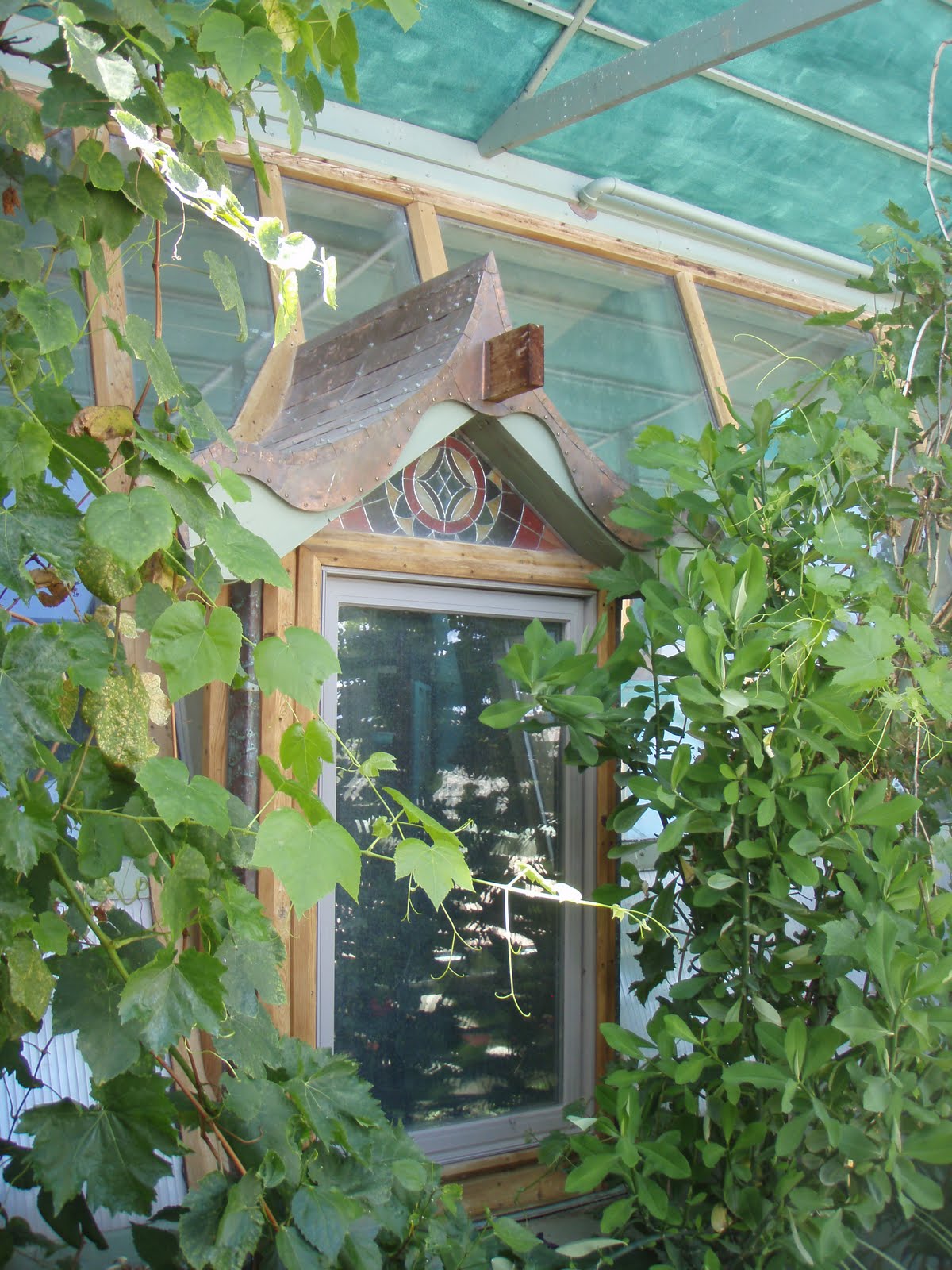
We took showers, ran blenders, watched TV, and turned on lights as we normally would, yet didn’t want for electricity, water, coolness or heat.  In fact, we only ran into problems when we didn’t use enough water in the sinks to provide greywater for the planters and had to occasionally water the greenhouse plants by hand.

It appears the biggest hindrance to future earthship construction is navigating the building codes of various counties across the US, which were written assuming conventional construction techniques and materials.

http://earthship.com/

http://www.garbagewarrior.com/about.html

Saturday, May 29, 2010

Hell's Backbone


Southern Utah conjures up many connotations.  Polygamous nutcases, redrock canyons, Ed Abbey, and the Grand Canyon are a few.  Within the raw, scorching desert the name Hell’s Backbone implies more sun, ATV’s, and lizards than normal.

No-harm Buddist organic farming wasn‘t immediately on my mind as we stopped in a cloud of dust at Hell‘s Backbone Grill in Boulder, Utah.  Not only were traditional prayer flags fluttering on the porch, they have the best tasting food in the entire state of Utah.

Blaker’s Acres, a farm located down the road from the Hell’s Backbone, supplies produce to the restaurant.  The manager of Blaker’s Acres took an entire morning to show us around and describe the Buddhist-inspired principles on which the farm operates.

Obviously, plants were killed to be eaten.  Otherwise, the farm operated as ‘No Harm’, meaning no pesticides, traps, or implements that would harm the multiple little creatures wanting to feast on the tasty plants.  There were a variety of methods used to do this.  Specific companion plants, when grown together, provided odors and/or tastes that would repel certain insects.  They plant extra produce with the expectation that deer and other fauna will find their way through fences or into cold cellars.  In addition, there are strong ties to orchards and ranches around Boulder to supplement the farm’s provisions through a fluid semi-barter economy in the absence of substantial hardware and grocery stores for a hundred miles.

And, should an infestation take a portion of the crop, or seasons change, the chefs at Hell’s Backbone adjust their menu to what is available.  I was personally skeptical of the pumpkin and tumbleweed enchaladas, but they were fantastic (it turns out that young green tumbleweeds are quite tender and tasty).

In addition, the restaurant gets its meat from ranchers a couple of miles away.  I think that it is fair to say that despite the variety of ideological, theological, and background experiences of the folks involved with Hell’s Backbone, their mutual dependence creates a strong community.

Friday, April 23, 2010

Findhorn Foundation


So here I am sitting in The Elephant House, the coffee shop where J.K. Rowling began writing about Harry Potter. I can see the Edinburgh Castle and the Greyfriars Church graveyard from the window. It makes Hogwarts all the more believable. It is day six of waiting out the volcano - if all goes well we fly back to the states tomorrow. However hard it was at first to accept the fact that we weren’t going to be able to keep our schedule, I am grateful now for the extra days to reflect on the last six weeks, and in particular the most recent week at the Findhorn Foundation.

Panorama of the Universal Hall

When I began planning this sabbatical focused on intentional living one of the first websites I found was the Findhorn Foundation. Its homepage said, “spiritual community, education centre, and ecovillage”. That got my attention. Then I discovered that they had a special week focused on eco-villages and I sent in our deposits. I had no idea what to expect but I knew I wanted to go.


I now can’t imagine this sabbatical without it. It is by far the largest and most complex of all the communities we have visited. It has evolved over time and continues to evolve. It is an eco-village and an interactive educational model for sustainability. It is a spiritual community. It is a creative and innovative community. It is an unfolding experiment. There is just no easy way to explain Findhorn. Even after a week of living and working in the community I am not exactly sure how it functions. But it is clear at least from my experience, that it is doing something right.


At the beginning of the week one our leaders, or focalizers as they were called at Findhorn, shared with us the following two statements about sustainable/intentional communities:

1. In communities that last - there is almost always a glue that holds the community together.
2. Sustainability must be fun. If it is isn’t fun it isn’t sustainable.

Findhorn definitely had a glue. Again easier to experience than to describe but it was about the way they connected to one another and to creation. They called it co-creation with nature. What does that mean? For me its something to do with the fact that the vision of being an eco-village does not come out of a moral or ethical obligation to care for the earth but out of a deep sense of connectedness, of oneness with nature and with all creation. This connectedness is not just an idea, it is something lived out in a very simple, very consistent manner. They take time to do what they call an attunement. Before any task, any activity, they hold hands in a circle and become aware of themselves, of one another. They listen for the spirit within. They listen to the elements around them. They pay attention to the energy of the group. They attune to themselves, to one another and to creation. It is a very powerful, simple practice that holds this incredibly diverse, incredibly complex community together. there is much more to say about this - but probably for another post.


I also cant remember a time when I have laughed as much as I did. This experience was fun. Lots of fun. And not superficial fun, but deep, satisfying, real belly-aching fun. And it wasn’t just our group of 25 that was having fun. People were on a whole, happy. Yes you could say it is easier to be happy when you are living in a commune of sorts on the northeast coast of Scotland. But then maybe there is something to learn here, about how people relate to one another, to themselves, to the larger world. There was an ease and a grace among this community that is rare. And I believe it has something to do with the glue that keeps them together.

Is Findhorn perfect? By no means. Does it have all the answers? Of course not. But as far as intentional, communal, sustainable living goes, it has wisdom to share. I am walking away from this eco-village Experience Week with a deep sense of gratitude, not only for the incredible people I met from around the world, (In our group of 25 participants we had people from Australia, Sweden, Italy, Switzerland, United States, England, Wales, Sri Lanka, Hong Kong, Slovakia, Spain, Canada, and the Netherlands) but also for the way it engaged my mind, body and spirit. I haven’t felt this whole in a long time. This thread of connection continues…

More to come…